Showing posts with label Fruit. Show all posts

Sunday, 18 October 2015

My favourite apple pie


Sour cream apple pie


I’ve been going a little crazy with the apples. The two young trees in our small city garden (a Bramley, because you have to, and a James Grieve) are bent low with fruit. Friends arrive from the country, or from their own corners of the city, with more bags of apples. The whole house smells of them.

I’ve juiced them and stirred them into cakes and puddings. At night, I let the dog out, turn on the dishwasher, lock up the house and spoon another batch of cooked apples into their muslin hammocks so they can drip drip drip their juice into bowls, to be made into herb jellies in the morning.


Friends arrive with apples.

And twice now, I’ve made this pie. It comes from TheSilver Palate Cookbook, an enormous favourite of mine, picked up on a trip to America in the 80s and now falling apart from decades of love and overuse.

I’m terribly keen on the cosy look of lattice-topped pie, something that would look good cooling on Laura Ingalls’ window sill in Walnut Grove. I could try and tell you how to do it here, but it would go on for ages and we might fall out. What you need is something from YouTube like this (if only for the use of the word ‘cattywampus’ at 8.05). For happiness, try to banish from the kitchen anyone who might be inclined to chip in with ‘You’re doing it wrong!’ at any stage.


Silver Palate Sour-Cream Apple Pie


Making the lattice.

This makes a deep pie with a tender crust - as it cooks, the topping bubbles and melts into caramelised lusciousness under the pretty lattice.  Serve it warm or at room temperature with thick cream, clotted cream or good vanilla ice cream.

I’ve metric’d the ingredients here, because we’re not actually in Walnut Grove, and I link here to the method from epicurious.  I used a mixture of James Grieve apples and Cox’s Orange Pippins – you don’t really want the fluffiness of Bramleys here.  I like to toast the walnuts very lightly in the oven before mixing them into the topping, about 5-6 minutes on an oven tray at 180°C/160°C Fan/Gas 4 should do it.

For the crust:
320g plain flour
60g caster sugar
¾ tsp salt
¾ tsp ground cinnamon
90g butter, chilled and cut into small cubes
90g lard, chilled and cut into small cubes
4-6 tbsps chilled apple juice or water

For the filling:
5-7 tart apples
160ml sour cream
75g caster sugar or vanilla sugar
1 egg, lightly beaten
¼ tsp salt
1 tsp vanilla extract
3 tbsp plain flour


For the topping:
3 tbsps light muscovado sugar
3 tbsps granulated or demerara sugar
1 tsp ground cinnamon
120g shelled walnuts (see note in introduction), roughly chopped


Filling the pie.


Crimped.

Thursday, 9 October 2014

Learning to love the muscat (it didn’t take long)


DSCF1676
 
I now discover I really like the muscat. This is the reverse of that syndrome where you drag home from your holidays a lurid liqueur (it’s almost always a liqueur), the drink that was so delicious over five-hour lunches on the terrace, only to find that back home it has all the charm of a Fairy Liquid daiquiri. I think the Ms Murderous Heels sour puss made the muscat taste of ashes in my mouth.
Anyway, I like it now. So that will teach her.

I’m always on the hunt for small cookbooks, the sort sold to raise funds for the church roof or the local sanctuary for tap-dancing owls, the ones with four-line recipes and no glossy pictures. So I was very happy to find Recettes d’un Petit Village en Languedoc. It’s a collection of recipes from the residents of Saint Xist, a little village in the Aveyron, collated by Denis Cristol to raise money for their twelfth-century priory. It contains a recipe by Régine Fargier for a simple cake made with muscat which, along with a bowl of very pretty purple plums, inspired a bit of tinkering about and this is the result. Try it. It’s very easy and looks impressive. If you like, you can serve it straight away, warm, as a pudding with cream, crème fraiche or custard. Or serve it cold. Whichever way you serve it, naturally a glass or two of muscat goes very well with it.


Plum and muscat cake
DSCF1685

This is really good with the plums, but in summer I imagine it would be really lovely made with peaches or nectarines too.


For the plums:
4-5 plums, just ripe, not too soft
3 tablespoons demerara sugar

For the cake:
250g caster sugar, vanilla sugar if you have it
200g unsalted butter, softened, plus a little more for greasing the tin
4 eggs, separated
2 teaspoons vanilla extract
250g plain flour
2 teaspoons baking powder
A good pinch of salt
200ml muscat

Some icing sugar for dusting, if you like
Serve with crème fraîche or lightly whipped cream


Preheat the oven to 180°C/Gas 4. Lightly grease a 23cm springform baking tin and line the bottom with baking parchment. Butter the parchment.

Halve the plums, stone them, and cut each half into four pieces. Toss them with the demerara sugar and line the tin with the pieces of plum. Try to cram them as closely together as possible.
Beat together the sugar and butter until pale and light. Add the egg yolks one at a time, beating well after each addition. Beat in the vanilla.
Sift together the flour, baking powder and salt into a separate bowl.

In another, scrupulously-clean bowl whisk the egg whites until they form peaks.
Begin to add the muscat and flour mixture to the batter in alternate batches, starting and ending with some of the flour (flour/wine/flour/wine/flour), folding in well with a spatula after each addition.
Fold in a third of the beaten egg whites with a spatula to lighten the batter. Then stir in the rest, lifting the batter with the spatula and gently folding it into the mixture. It should be well combined but you want to keep in as much air as possible. Spoon the mixture over the top of the plums, smooth the top with a spatula, place the tin on a baking tray and bake in the oven for about 55 minutes – a skewer inserted into the middle of the cake should come out clean. It may need a little bit longer. Put it back into the oven and test every 5 minutes.

Place the cake tin on a cooling rack. Run a palette knife around the sides of the tin but leave it to cool for 15 minutes before releasing the sides of the tin and turning it out onto a plate. Gently remove the base of the tin and the baking parchment; serve warm or cold.

Wednesday, 18 September 2013

A taste of figs


DSCF1038

A box of figs, £3.49.

When we went to the Turkish Food Centre on Sunday I bought a whole case of figs for £3.49. They were sticky and ripe, the kind you can eat greedily with the skin on, spitting out only the stalk. I think there’s something a little revolting, life-denying, about peeling figs. They look so raw and unappealing, like dead baby mice.

Of course, when you’re buying them as ripe as this you need to use them within a day or so. I like them with yoghurt for breakfast or cooked on the griddle with some slices of halloumi and a trickle of honey, maybe a few slivers of toasted almonds. But there are a lot of them in a box.

DSCF1081

Figgy lunch, with halloumi , almonds, thyme, olive oil and honey.

I’ve wanted to try making a fig liqueur since Séan and I were offered sticky little glasses of the stuff to round off dinner at one of our favourite local restaurants, the almost painfully charming and invariably delicious Oui Madame! on Stoke Newington High Street.

I’m not sure if what we tried was Figoun, the Provençal fig liqueur made from red wine, figs, vanilla, angelica, oranges and tangerine among other, secret ingredients, but I thought I’d try combining figs, vanilla sugar, orange zest, red wine and a slug of cognac and see how I get on.

I think it should be quite good by Christmas, even better by next Christmas. If you’d like to try it, I’m giving you the recipe I’ve used here but of course it’s something of a leap of faith. I’ve never made this before. I’ve no idea if it will work, but if it does won’t we all be enormously pleased with ourselves on Christmas Day?

Fig Liqueur

hp_scanDS_622816322951

This lovely illustration is by my Twitter friend, artist Anna Koska (@gremkoska). Do take a look at her website here.

[Copyright: Anna Koska]

When you’re buying figs, especially if you’re buying them by the box, lift them out of their pretty paper cases and inspect them for mould – the mortal enemy of figs everywhere. One mouldy fig will turn the rest very quickly indeed.

Should make about 1.5 litres. We’ll see.

600g figs
225g caster sugar or vanilla sugar, I used vanilla sugar
1 strip of orange peel, pared with a very sharp vegetable peeler, any white pith removed
1 bottle fruity red wine, plus a bit, enough to almost fill the jar
100ml cognac
You’ll need 1x2l cold, sterilised jar and some cold, sterilised bottles to decant the liqueur into

DSCF1042

Cut figs…

DSCF1085

Macerating in sugar…

DSCF1088

Add the wine and cognac.

Wash the figs, trim off the hard stem and cut into eighths. Place some in the bottom of the jar and scatter some of the sugar on top. Continue layering fruit and sugar until you’ve used them all up. Seal the jar and put in a cool place for 2-3 days, turning it every day until the sugar has dissolved.

Add the orange zest. Pour in the wine and cognac. Seal and store the liqueur in a cool, dark place for a couple of months, shaking the jar every week or so. Strain through a sieve and then strain again through a sieve lined in muslin. Pour into cold, sterilised bottles and seal. Ideally, leave it for a month or so before drinking.

Friday, 13 September 2013

A Sweet Consolation Prize


Autumn is a second spring when every leaf is a flower.

Albert Camus

IMG_00000164

A bowl of Bramleys from our tree.

Summer left like a well-mannered guest, slipping away quietly, without fuss. There are fewer dinners in the garden, sitting around into the night over the end of the cheese, picking at soft fruit and polishing off the last of the rosé. Washing takes longer to dry on the line. We reacquaint ourselves with the sock drawer after weeks of neglect. And then suddenly the greengrocers’ shelves are filled with figs, damsons, cobnuts and ruby-skinned pears.

Hello, autumn. We’ve been expecting you.

If I plunged my hand into a bag of favourite autumnal words, pulled out five, arranged them into an order and then created a recipe from that, this is what would happen.

Browned butter caramel apple cake

IMG_00000189

A slice of cake for breakfast.

I made this cake with the apples from our small, espaliered Bramley, which this year is doing everything in its power to make me love its twiggy self. It is so heavy with fruit it will keep us in pies, cakes, jellies and chutneys all winter.

Don’t be put off by the longish list of ingredients. You probably have most of them hanging about anyway.

IMG_00000177

Browned butter caramel apple cake. I think I love you.


For the cake:
250g unsalted butter, cubed, plus a little more for greasing the tin
200g plain flour
50g ground almonds
1 tsp baking powder
½ tsp salt
½ tsp ground cinnamon
¼ tsp freshly grated nutmeg
100g light muscovado sugar
100g caster sugar
4 eggs, lightly beaten
1 tsp vanilla
1 tbsp cognac, cider brandy or calvados (optional but good, obviously)
About 3 cooking apples, peeled, cored and cut into chunks, about 300g prepared weight


For the caramel sauce:
120g unsalted butter
120g light muscovado sugar
60ml whole milk
Good pinch of flaky sea salt

Preheat the oven to 160°C/325°F/Gas 3. Lightly butter a 22cm springform cake tin, line the bottom and sides with baking parchment and lightly butter the parchment.

Warm the butter in a medium-sized saucepan over a medium heat (a stainless steel pan is better than a dark-bottomed one as it’s easier to see how brown the butter is getting). The butter is ready when it’s a rich shade of hazelnut brown and it smells nutty and delicious. Pour it into a bowl to cool.

In a separate bowl, whisk together the flour, almonds, baking powder, salt, cinnamon and nutmeg.

When the butter is cool, tip it into the bowl of a stand mixer with the sugars and beat until creamy and light, about 5 minutes. With the motor still running, slowly pour in the eggs, pausing from time to time to make sure everything’s well incorporated. Beat in the vanilla and booze, if you’re adding it. On a low speed, beat in the flour mixture being careful not to overmix.

Pour the batter into the prepared tin and scatted the apple pieces evenly over the top. Bake for 50-60 minutes, until a toothpick inserted into the middle comes out clean.

Place the tin on a wire rack while you make the caramel sauce.

Melt the butter in a small saucepan over a medium heat. Whisk in the sugar, milk and salt. Keep stirring vigorously until everything blends into a smooth, silky sauce and simmer until thickened slightly. Pour half of the sauce over the cake, making sure it’s evenly distributed, and leave it for 10 minutes until it’s fully absorbed into the cake.

Remove the cake from the tin, peel off the parchment and put the cake on a plate. Pour over the remaining sauce and let it trickle down the sides. Leave the cake to cool completely then serve in fat slices with generous spoonfuls of crème fraiche, greek yoghurt, clotted cream or vanilla ice cream.

Tuesday, 19 February 2013

Baking for a Sweeter Tomorrow


DSCN8467


This cake is my insurance policy for a sweeter tomorrow. When you have a selection of cakes covered in icing, fruit and chocolate as we did for Séan’s birthday, a humble brown cake doesn’t exactly steal the limelight. When all else is but crumbs, there’s every chance you will have a slice or two of apple cake left the next day to enjoy in blissful isolation with a cup of coffee.

DSCN8506

Just the right amount of leftovers.

I based this cake on a recipe I found here. I adjusted it to work in a two-litre bundt tin as I don’t have a three-litre one, and added maple syrup to the glaze. I also sprinkled over some praline, as I think it’s often good to have a little sweet, nutty crunch with your cake, but you can leave it out if you like.

Spiced Apple Bundt Cake with Maple Syrup Glaze

DSCN8500

For the optional praline:

125g shelled hazelnuts
200g caster sugar

For the cake:

200g plain flour, plus a little more for dusting the tin
1 tsp bicarbonate of soda
1 tsp ground cinnamon
½ tsp freshly-grated nutmeg
¼ tsp ground cardamom
Good pinch of ground cloves
½ tsp salt
400g apples
225g unsalted butter, softened, plus a little more for dusting the tin
250g caster sugar
80g light muscovado sugar
Finely grated zest of a lemon
2 eggs
1 tsp vanilla extract
1 tsp lemon juice
3-4 tbsp milk

For the glaze:

70g light muscovado sugar
50ml whipping cream or double cream
2 tbsp maple syrup
30g unsalted butter
1 tsp lemon juice
½ tsp vanilla extract
¼ tsp salt

If you’re using the praline, make it first. Preheat the oven to 180°C/350°F/Gas 4. Scatter the hazelnuts in a roasting tin and place them in the oven. If the hazelnuts still have their skins, roast for 7-8 minutes until the skins are just blackened. Tip them into a clean tea towel, cover and leave for a minute before rubbing vigorously to remove the skins – don’t worry too much about getting every speck off. If they’re already skinned, simply roast them for 5 minutes or until lightly toasted.

Line a baking sheet with Silpat or lightly buttered baking parchment. Warm a heavy-bottomed frying pan over a medium heat – it’s best to use one with a shiny interior rather than a dark, non-stick one as it will make it easier to see when the caramel is the right colour. Tip the sugar into the pan in a thin, even layer. When the sugar starts to melt, stir it gently to encourage it to melt evenly. When it has dissolved, stop stirring and watch it carefully. When it has turned a rich, golden amber, tip in the nuts and quickly stir with a fork before tipping out onto the prepared baking sheet. Cool completely then either chop roughly with a knife or pulse in a blender. You’ll have more than you need for this cake, but it keeps well in an airtight jar and you can use the leftovers to decorate other cakes and puddings.

Lower the oven temperature to 160°C/325°F/Gas 3. Thoroughly grease a two-litre bundt tin with butter. Scatter in some flour and cover the tin with cling film. Give everything a very good shake, remove the cling film and tap the tin to remove excess flour. This will show up any spots you’ve missed with the butter, so give them a little touch up.

Sift together the flour, bicarbonate of soda, spices and salt. I sift them twice so that everything is well combined but I’m sure this isn’t strictly necessary.

Peel and core the apples and grate them coarsely. Pat them with some kitchen paper to remove excess liquid. You should have about 225g apples.

In a stand mixer, beat together the butter and sugars until fluffy. Add the eggs one at a time, beating well after each addition. Beat in the vanilla, lemon zest and juice. Fold in the flour mixture with a metal spoon and then gently fold in the apples. Mix in enough milk to make a smooth batter. Spoon into the prepared tin and gently smooth the top with the back of a spoon. Bake for about 45-50 minutes until a toothpick comes out clean. Cool in the tin for 15 minutes then turn out onto a rack set over a plate.

While the cake is cooking, make the glaze. Stir together all of the ingredients in a small, non-stick pan over a low heat until all of the sugar has dissolved. Raise the heat slightly and whisk until the mixture comes together into a smooth, glossy sauce.

While the cake is still warm, pierce the top all over with a skewer and pour over the glaze, allowing it to soak into the cake before pouring over more. Use a spatula to scrape the glaze which has dripped from the cake onto the plate back into the pan. Warm it through and pour it over the cake. Sprinkle on some praline and cool for a further 30 minutes. Serve warm or at room temperature.

Saturday, 16 February 2013

There’s Only So Much Toast


DSCN8465

Every year I make marmalade. I love the restful, rhythmic chopping and the smell of it simmering in the pan. I love the look of a pleasing stash of gleaming, amber jars of it on the shelf. I love it on toast.
But let’s be honest, there’s a limit to how much toast a girl can eat in a year. I’m always looking for ways to include it in things as well as on things. I use marmalade to glaze hams, in a sticky glaze for chicken drumsticks, in steamed puddings and in cakes.
For Séan’s birthday, I wanted to make a marmalade cake based on this favourite Nigel Slater recipe for a loaf cake. In honour of the boy’s birthday, I gussied it up with a bit of booze, a thick layer of chocolate ganache and some sparkling, crystallised orange slices so in the end it was rather like a huge, posh Jaffa Cake.
DSCN8469
Planet cake.

Marmalade and Chocolate Cake


DSCN8493

For the crystallised oranges:
1 small orange, thinly sliced and ends discarded 200g caster sugar 750ml water 1-2 cardamom pods, bashed, optional


For the cake:

175g unsalted butter, softened, plus a little more for buttering the tin
100g marmalade Finely-grated zest and juice of a large orange 1 tbsp Cointreau, optional 175g caster sugar 3 eggs, lightly beaten 175g self-raising flour, sifted Pinch of salt

For the syrup: Juice of 1 large orange Juice of 1 lemon 100g icing sugar 1 tbsp Cointreau, optional

For the ganache: 200g dark chocolate 200ml double cream

Start by making the crystallised oranges the day before you want to make the cake. Put the sugar in a pan with the water and cardamom pods if using and stir over a low heat until the sugar dissolves. Raise the heat, add the orange slices and simmer gently for a couple of hours until the oranges are completely soft and have lost all trace of bitterness. Leave overnight to cool in the syrup. Remove the slices with a slotted spoon and pat dry on kitchen paper. Reserve the syrup. It will keep in a jar in the fridge for several weeks. Use it to glaze cakes, poach rhubarb, trickle over Greek yoghurt or to use as a base in cocktails.
Preheat the oven to 180°C/350°F/Gas mark 4. Lightly butter a 23cm springform cake tin. Line the bottom and sides with baking parchment and butter the parchment.
In a small bowl, whisk together the marmalade with the juice and finely-grated zest of the orange, and the Cointreau if using.
In a stand mixer, beat together the butter and sugar until pale, light and fluffy. Pour in the beaten egg a little at a time, beating well after each addition. Beat in the marmalade mixture. Remove the bowl from the stand and gently but thoroughly fold in the flour and salt with a metal spoon. Spoon into the prepared cake tin and smooth the top. Bake for 25-30 minutes until a cocktail stick inserted into the middle comes out clean.
While the cake is baking, make the syrup. Place the orange juice, lemon juice, Cointreau if using and icing sugar into a small pan. Warm over a low heat until the sugar dissolves. Remove from the heat.
As soon as the cake comes out of the oven, pierce it all over the top with a skewer. Pour on a little of the syrup, let it soak in and then pour on a little more until you’ve used it all up, making sure the cake is evenly soaked. Cool completely in the tin then remove it carefully from the tin (the syrup will make it a bit fragile). Remove the baking parchment and invert onto a plate.
To make the ganache, break up all of the chocolate into small pieces and place them in a bowl. Heat the cream in a pan just until bubbles appear around the sides, then pour it over the chocolate. Leave it for 30 seconds then stir it until the chocolate is completely melted. Spread the chocolate over the cake and top with the orange slices.

Monday, 4 February 2013

Marmalade and Sunshine


DSCN8285

When I began slicing the Seville orange peel into pretty slivers, the sky was dark and the treetops were doing a dance in the wind, whipping violently from one side to the other in a maniacal tango. By the time I’d finished, the sky was blue and golden light tumbled across the garden. It’s official. Marmalade makes the sun come out.

I’ve been mainlining citrus recently. It is one of winter’s greatest compensations, along with crocuses, porridge with cream and log fires. Each morning, as I walk back from the park with Barney, I drop in at my favourite greengrocer. At this time of year I often pick up some blood oranges, sherbet-y Sicilian lemons or juicy little limes. And when the Seville oranges appear in all of their bumpy-skinned loveliness, I know it’s time to drag out the preserving pan.

DSCN8283

So good with simit rolls for breakfast.

I used Dan Lepard’s recipe. It’s delicious as it is, or if you like you can add 50ml of whisky at the end of cooking to give your breakfast toast an extra kick.

This year my marmalade making was made a little easier by my new eBay bargain, a citrus press. I bought it because I’ve been making a glass of blood orange juice for breakfast (Tip: add a splash of rosewater. So good.) each morning and I wanted to shorten the distance between my half-awake state and good humour. But it certainly made quick work of juicing all those sevilles and left smooth, clean orange halves all ready to chop up. I’d say that was a tenner well spent.

DSCN8246

Seville oranges, ready to go.


DSCN8251

Putting my ebay bargain through its paces.


DSCN8255

Chopping the peel.


DSCN8260

Soaking the peel.


DSCN8262

Already well into the first jar.

DSCN8294

Monday, 28 January 2013

Come To Lunch, Bring Your Slippers

DSCN8225

Last Saturday night, as I roasted and whisked and rolled, I wondered if it all might be in vain. I was prepping for a Sunday lunch which might never happen. I dusted the counter with flour to roll out the pastry as snow fell heavily on the kitchen’s glass roof. The cats shot through the catflap and threw themselves in front of the fire where they meticulously licked fat flakes from their whiskers and paws.

Lunch the next day was to welcome home four of our closest friends, Vanessa and James from Cambodia and Richard and Stuart from Australia. Their planes were due to arrive at Heathrow between five and six on Sunday morning. It seemed a good idea, on Boxing Day, when we discussed getting together for a jet-lag-deferring Sunday lunch. But now every news bulletin came with dire updates about runways being closed. Newspapers screamed about ‘Snowmageddon’. Perhaps it would just be Séan and I, tucking into that rolled shoulder of pork and rhubarb and custard tart?

But planes landed. Guests came. Radiators were draped with lightly steaming mittens and scarves. Pegs struggled under the weight of damp wool and fat down coats. Boots lay in a heap in the hall. They’d all brought their slippers. I like that. I like having a house where people pad about in their slippers. It’s what makes it home.*

DSCN8224

DSCN8229

Snow soufflés rise from plant pots.

DSCN8230

Frosted magnolia.

DSCN8245

A present from Cambodia. Silk, peppercorns, peanut brittle, a little aluminium coffee filter and ground coffee which smells so deliciously of chocolate, I want to rub my face in it.


*Or perhaps a prelude to The Home, where I hope we’ll all end up one day, surviving on soup, show tunes, gin and gossip, cheating at cards and fighting over the best lounger on the terrace.


Rhubarb and Custard Tart

DSCN8236

Back in 2008, on the very first shoot I did for River Cottage, we made this pretty, and pretty delicious tart . I’ve made it quite often since and I’ve tinkered with it slightly, adding some orange zest to the pastry and cramming in even more rhubarb, because you really can’t have too much of a good thing.

For the pastry:

225g plain flour, plus a little more for dusting the tin
110g unsalted butter, softened, plus a little more for greasing the tin
110g caster sugar or vanilla sugar
A few gratings of orange zest
Pinch of salt
4 egg yolks, lightly beaten


For the filling:

800g rhubarb, trimmed and cut into 5cm pieces
Zest of 1 small orange
Juice of half an orange
3 tbsp caster (or vanilla) sugar
1 vanilla pod, split and cut in half


For the custard:

250ml double cream
1 vanilla pod, split
5 large egg yolks
2-3 tbsp caster (or vanilla) sugar
IMG-20130119-00198

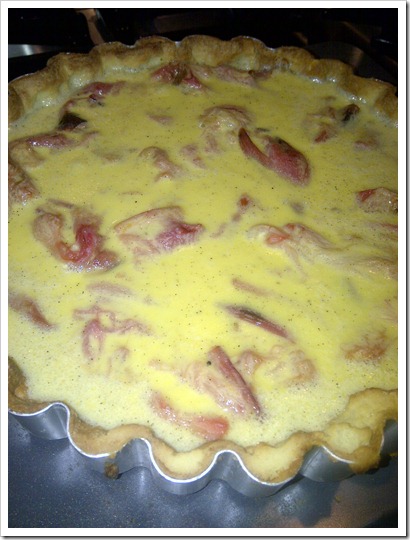
Sorry this picture is a bit rubbish. Snapped it on my phone just as I took the tart out of the oven and I forgot to take a new one the next morning, but it gives you an idea of the fruity, vanilla-y goodness.

First, make the pastry. Lightly greasy a 28cm, loose-bottomed flan tin, dust it with flour and tap out the excess. Sift the flour into a bowl and rub in the butter with your fingertips until it resembles fine breadcrumbs. Whisk in the sugar, zest and salt with a fork. Add the egg yolks and mix with a knife until the dough comes together. Knead very gently and quickly into a round, smooth disc. Wrap in cling film and refrigerate while you prepare everything else.

While the pastry is resting, roast the rhubarb. Preheat the oven to 200°C/400°F/gas mark 6. In a roasting tin, mix the rhubarb, zest, juice, sugar and vanilla, then bake for 30 to 40 minutes, until soft and slightly caramelised. Cool, strain off the juices (save it to pour over greek yoghurt – so good) and remove the vanilla. You can rinse and dry the vanilla pod and use it in the custard if you like. Thrifty.

While the rhubarb is cooling, line the tart tin. On a lightly floured surface (or between two sheets of baking parchment or cling film), roll out the pastry and line the baking tin, letting the excess pastry hang over the side. Refrigerate again for 15 minutes or so.

Reduce the temperature to 180°C/350°F/gas mark 4.

Line the tart tin with several layers of cling film, leaving plenty hanging over the side. Fill generously with baking beans or uncooked pulses or rice. Bring the excess cling film over the top to make a sort of blind baking ‘pad’. Place on a baking sheet and bake for 12-15 minutes. Remove from the oven, take out the ‘pad’ and prick the pastry all over with the tines of a fork. Brush lightly with egg wash (steal a little of the egg yolk from the custard and whisk with a splash of water or milk) and return to the oven for about 8-10 minutes, until the case is golden and completely cooked through. Remove from the oven and trim off the excess pastry with a small, sharp knife.

Reduce the oven temperature to 130°C/250°F/gas mark ½.

Make the custard. Pour the cream and split vanilla pod into a pan and heat until the cream is just scalded. Whisk the egg yolks and sugar, then pour into the cream, whisking to combine. Pour through a fine sieve into a jug. Scrape the seeds out of the pod and into the custard.

Spoon the rhubarb into the pastry shell and pour over the custard until it's about 5mm from the top. Bake on a tray for 30-40 minutes, until the custard is just set but not too firm – it should still have a little wobble to it. Serve cold.
DSCN8237

Sunday, 23 December 2012

Scents of Christmas

DSCN8081

The sight of the tree glittering in the dining room window, twinkling fairy lights twining up the banisters and streams of cards dangling from ribbons stapled into the top of the sitting room doors lifts my heart at Christmas. But more than that, more than that, I love the way the house smells.

IMG-20121217-00110

The wreath on the front door, covered in oranges and lemons studded with cloves, sprigs of bay, bundles of cinnamon and dried orange slices, smells as good as it looks. The oven, with some assistance from me, churns out cookies and cakes, hams and sausage rolls, filling the house with delicious aromas. Pots of hyacinths and jasmine, vases of eucalyptus and off-cut pine branches from the tree, are crammed on every mantel, side table and desk.

20121223_154932v2

Along the sitting room mantel, I place candles stuck into old terracotta pots filled with damp sand (you could also use florists’ oasis). I cram them with clippings of myrtle, rosemary, Christmas box and bay from the garden. It takes minutes and smells wonderful. On Christmas Day, I’ll steal the candles from the sitting room and use them to decorate the dining table.

DSCN8092
Candle pots, decorated with myrtle, Christmas box, rosemary and bay from the garden.

I dry dozens of orange slices in December (see method, below). It’s easy and cheap and I use them in so many different ways - on the wreath, tied in bundles on the tree and in quick Christmas pot pourri.

DSCN8070
As well as making ooh-la-la pot pourri, I also just fling leftover citrus peels into the fireplace, where they dry and turn into very good, sweet-smelling firelighters.

For this, I mix the orange slices in a bowl with whatever I can grab from my spice drawer: cinnamon sticks, star anise, cloves, cardamom pods and cassia bark (available very cheaply in big bags from Indian supermarkets). To this base mixture, I add fresh bay leaves and rosemary from the garden so I can enjoy their sweet, spicy, piney scents as they dry. I also stud a few oranges and lemons with cloves and toss these in the bowl too. The base mixture, with perhaps just a few drops of essential oil (sweet orange, frankincense, cedar, scotch pine and clove are all good, alone or in combination) to intensify the scent, bagged up and tied with a pretty ribbon, make a very good, inexpensive present.
What scents say ‘Christmas’ to you?

DSCN8080
Use a darning needle to make a hole in the peel before pressing in the clove – it’s a lot easier on your hands.

DSCN8075
Christmas pot pourri.

How to Dry Orange Slices:
IMG-20121210-00088

Preheat the oven to 130C/250F/Gas mark ½ .

Trim the ends off the orange and then slice thinly, about 3mm thick, with a sharp knife. Place sheets of baking parchment on metal cake cooling racks and arrange the orange slices on top. Place them in the oven. After 15 minutes, turn the temperature down to 110C/225F/Gas mark ¼ . After an hour or so, turn the slices over and return them to the oven. Keep an eye on them, turning from time to time. When they’re almost dry, turn the oven off and leave the orange slices in the oven until cold. The idea is to get them thoroughly dry but not to over ‘cook’ them as you want to keep the colour as vibrant as possible, so keep an eye on them and adjust the timings to suit your oven.

Thursday, 6 December 2012

Are we there yet?

DSCN7907

Here we are on Day 800 of our Christmas preparations and I feel like I’m on first name terms with every single piece of dried fruit in my larder. But this mincemeat really is worth the tiny bit of effort involved in making it. It will see you through an Office Hero quantity of mince pies and if you have any left, you could try this Mincemeat Crumble Tart which makes a nice alternative to a traditional pudding on Christmas Day for those of you who don’t care for it. I know you’re out there.

While we’re on the subject of puddings and fruity things, I’m a bit furious at Morrisons for their Christmas advert which features a little boy sneaking some Christmas pud to his dog under the table. Unless you want this Christmas to live on in family memory as the one where Timmy accidentally killed Rover, this is a really bad idea. Raisins, currants and sultanas can be highly toxic to dogs and ingesting them can lead to renal failure and death. Not very festive.

I know this because a couple of years ago, I had a box filled with Christmas puddings sitting in the corner of my dining room ready to do a taste test for a magazine feature. Our dog Barney got into the box, into one of the puds and was halfway through it before I discovered the crummy little buggar. Cue a trip to the vet’s, charcoal tablets, three days on a drip and a bill of ‘nice little holiday somewhere warm’ proportions. So don’t be as silly as Morrisons and do keep all of the pud, cake and pies for yourself.

Plum and apple mincemeat
DSCN7903

This recipe comes from River Cottage Handbook No. 2 Preserves, by Pam ‘The Jam’ Corbin. Pam’s recipe is unusual as it contains no suet. I like this as I think it gives the mincemeat a fresher, cleaner more lively flavour. Pam uses Russet apples but I didn’t have any of these kicking about so used Blenheim Orange instead. This is one of my favourite apples, great for eating and cooking, so grab some if you can find them.

DSCN7897

Makes 4 x 450g jars

1kg plums 
Finely-grated zest and juice of 2-3 oranges (200ml juice)
500g russet apples, peeled, cored and chopped into 1cm cubes 
200g each currants, raisins and sultanas 
100g orange marmalade 
250g Demerara sugar 
½ tsp ground cloves 
2tsp ground ginger 
½ nutmeg, grated 
50ml ginger cordial or wine (optional) 
100g chopped walnuts 
50ml brandy or sloe gin

Wash the plums, halve them and remove the stones. Put them into a saucepan with the orange juice and cook gently until tender. This could take as little as 15 minutes but may take longer if your plums are not very ripe. Blend into a purée in a blender or liquidiser, or press through a sieve. You should have about 700ml plum purée.

Put the purée into a large bowl with the rest of the ingredients, apart from the brandy or gin. Mix thoroughly, cover and leave for 12 hours.

Preheat the oven to 130˚C/250˚F/Gas mark ½. Put the mincemeat in a large baking dish and bake, uncovered for 2 – 2 ½ hours until thickened. Stir in the brandy or gin (it will bubble up and steam quite a bit), then spoon into warm, sterilised jars, making sure there aren’t any air pockets. Seal and store in a dry, dark, cool place until ready to use. It will keep for up to 12 months.

DSCN7910
DSCN7924
IMG-20121204-00078
DSCN7898
Related Posts Plugin for WordPress, Blogger...