Showing posts with label Starters. Show all posts

Saturday, 7 November 2015

Home again

Liptauer, an easy and delicious snack.

London is dark and damp. Walking Barney in Abney Park on Friday morning, the bitter smell of sulphur from the previous night’s fireworks hung in the air.


A damp dog walk in Abney Park.

But all is not dreary. Our local church hall is hosting an evening of Sing Along A Sound of Music to raise money for UNICEF’s Sing for Syria appeal and my friend Liz has signed me up to help decorate the entrance to the hall in a suitably Austria en fête fashion. So last night, in Episode 1127 of my Jill Archer life, Liz came round to discuss the suitability of floral fabrics pulled messily from my craft cupboard and how many fairy lights was too many fairy lights. And by discuss I mean drink, and by fabric I mean wine.

The Sound of Music is the first film I remember seeing, with my dad and my grandmother, aged about five or six, back in the day when small market towns still had cinemas, so it’s always had a special place in my heart.

I also spent part of the summer I was 15 staying with friends of my parents in Vienna. My strongest memory of that trip is seeing women wearing dirndls in an entirely unironic fashion, to go to the office or walk to the post box. But I also remember eating liptauer, the hummus of the Austro-Hungarian empire, as a mid-afternoon snack. This spicy, paprika-spiked spread is terribly easy to make and I thought it would see Liz and I through our important decoration discussions. And it goes well with wine.

Liptauer
The things that make liptauer taste so good.

You can leave the butter out of this if you like (that’s not something I often say), and just make up the weight with more cream cheese or quark. Or you can substitute some cottage cheese for either. Just make sure it’s mixed until very well blended.

Serves 4 as a snack, or more as part of a selection of starters

100g butter, softened
200g quark (or cottage cheese, if that’s your thing)
180g tub of cream cheese
3-4 cornichons, diced
3 spring onions, white and pale green part only, finely diced
1 tbsp sweet paprika
1 tbsp capers, rinsed if salted, roughly chopped
2 tsps white wine vinegar, cider vinegar or juice from the cornichon jar
1 tsp caraway seeds
A good pinch of hot paprika
Salt and freshly ground black pepper

To serve
Rye bread, more cornichons and other pickles, chopped boiled egg

In a mixer or with a wooden spoon, beat the butter until smooth then beat in the quark and cream cheese a little at a time until very smooth. Beat the rest of the ingredients until well combined. Taste and season with more salt, pepper and/or vinegar or cornichon juice if required.


Beating everything together.

You can make the liptauer up to a couple of days ahead. I suggest you make it at least a couple of hours ahead for the flavours to develop. Seal in a tub or in a bowl with clingfilm and remove from the fridge about an hour before you want to serve it. Give it a good stir, spoon it into a serving bowl and sprinkle over some hot paprika.

Serve with rye bread (you can lightly toast this if you like) and more pickles, and/or some chopped boiled egg.

Monday, 3 December 2012

Kipper pâté


IMG-20121121-00043

When I was about six, I lived in a house where the kitchen had wooden saloon doors which swung out into the dining room. As I spent most Saturday afternoons watching cowboy films, I thought this was brilliant. It also allowed for a perfect ‘ta-daaaah!’ moment when I brought something out to the table. It’s hardly surprising I learned to love cooking early.

In that little kitchen, I performed my first experiments, mostly drawn from the pages of a free Be-Ro recipe booklet – rock cakes, fairy cakes, Victoria Sponge – the sugary, buttery, floury triumvirate of the 70s tea.

The first savoury dish I ever remember making was tuna fish pâté. I don’t recall there being any cookbooks in that house, other than the free pamphlet sort, so the recipe probably came from the back of the tuna tin.

It went something like this: Drain the tin of tuna then pound it together with half its weight in softened butter and season with black pepper and a little lemon juice (from a squeezy Jif plastic lemon, of course). Spoon into a bowl and arrange on a plate with some Jacob’s crackers. Leap through the saloon doors and serve to your flame-haired mum and flame-haired neighbour Bernice, who are probably drinking sherry and listening to Glen Campbell. They will try very hard to look pleased and not get too many buttery stains on their suede trouser suits as Glen trills, ‘And I need you more than want you, and I want you for all time…’ for the third time that afternoon.

I was thinking about my early kitchen experiments the other day when The Handpicked Collection sent me some oak-smoked kippers. I do a little consultancy work for them and they wanted me to try a few of the things from their new Foodstore Collection. I adore kippers for breakfast with a poached egg, but I also thought it might be time to revisit another 70s dinner party classic, kipper pâté. (Taaa-daaah! Door swing.)

Now if you, like me, love kippers but are sometimes put off cooking them because of the lingering smell, here are my top tips. For recipes like this one, ‘cook’ the fish in boiling water in a jug which dramatically reduces the whiffy-ness.

Of course, for breakfast kippers, you’ll want to brush them with melted butter, grind some black pepper on them and grill them. This is much more smelly but infinitely more delicious if you want to eat the kippers as they are. In this case, remove all of the fishy remnants, the bones and heads, from the house as soon as possible. Do not read the paper, do not finish the crossword, do not check your emails. Bag up all of the bits and put them in the outside bin. Dump the grill pan in a bowl of soapy water. Put a small pan of water on the stove with some chopped up lemon or orange, a cinnamon stick, some cloves, star anise – raid the spice drawer for anything which smells delicious, essentially - and let it bubble away for a bit. You might also consider making a cake. This is the best case scenario. You’ve had kippers for breakfast, your house smells delicious and you have cake for later. Or right now. As a reward for all of that hasty housekeeping.

Kipper pâté

DSCN7714

1 pair of kippers, about 600g (which will produce about 350g flaked fish)
300g unsalted butter, cut into cubes and softened
¼ tsp cayenne pepper
Juice of half a lemon
A bay leaf
Salt and freshly ground black pepper

Place the kippers heads down in a large jug and fill up with water from the kettle so that they are completely submerged, bar the tails. Leave them for 10 minutes and discard the water. (Fill the jug with soapy water.)

When the kippers have cooled down a little, remove the heads and bones. It will take a little while to pick out as many of the tiny bones as you can, but that’s what Radio 4 plays are made for.

Put the flaked fish into a food processor with 200g of the butter, the cayenne pepper and lemon juice and pulse until fairly smooth. Taste and season with salt and pepper (you may not need much, or any, salt as the kippers are already quite salty). Spoon into a pot or jar.

Melt the remaining butter in a small pan and let it cool slightly. Carefully pour into a small jug, trying your hardest to leave as much of the cloudy milk solids in the bottom of the pan as possible. Place the bay leaf in the middle of the pâté and pour the butter over the top. Cover and refrigerate until the butter is set. It’s even better the next day and will keep for about 4-5 days in the fridge if covered tightly with cling film or foil. Serve with hot toast. Or Jacob’s crackers. Taaa-daaah.

Thursday, 28 July 2011

Orage-ously good chicken

Orage-ously good chicken

Agde has been hot - the kind of humid heat that interferes with sleep, melts make up, frizzes hair. On the terrace of the Café Plazza, as tinny, consumptive Peter Gabriel or Police wheezed out from the speakers, locals muttered about ‘un orage’ over tiny cups of coffee and breakfast beers.

Well today the orage came, splashing, running, pelting down from the skies, spilling from the gutters, filling the age-smoothed grooves in the basalt terrace like tiny rockpools. It was a day to remain behind the wooden door.

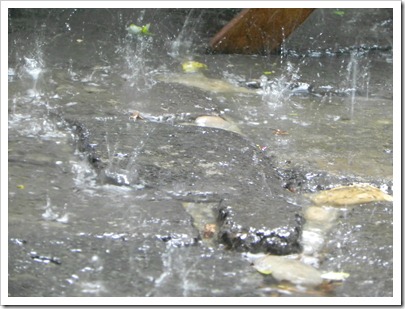
Rain in Agde

Splashing rain in AgdeRain splashing on the basalt terrace.

Almost the very second we were due to leave London, the car rammed to the rafters with towels and straw hats, proper pillows, paperbacks and favourite knives, the postman delivered a parcel, a birthday present from my sister-in-law. It was Dorie Greenspan’s lovely  Around My French Table. It was my companion throughout our 17 hour journey, especially during the boring bits before you get to Clermont Ferrand where France begins to roll downhill to the south.

I gave the book to my nephew Angus to look at and told him we could make what he liked. He’s going to university in the autumn (biochemistry – what the hell?) and wants to learn to cook a bit. His mother’s from a Spanish Basque family so his heart, appetite and genes lead him to Dorie’s Chicken Basquaise, a colourful jumble of peppers, chillies, tomatoes and chicken, a perfectly sunny dish for an extravagantly rainy day.

Dorie Greenspan’s Chicken basquaise
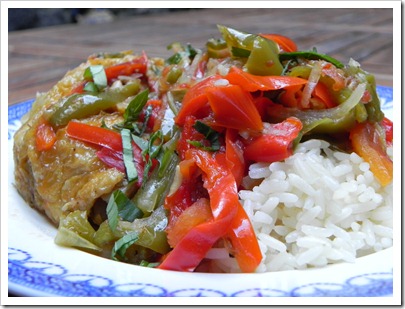
Chicken basquaise in Agde

If you’re keen on French food, you really need to buy Dorie Greenspan’s book. Probably today, if it’s not too much trouble. In her introduction, she says ‘This is elbows-on-the-table food, dishes you don’t need a Grand Diplôme from Le Cordon Bleu to make’. ‘Elbows-on-the-table food’ is a pretty good description of the food I love and so many of my favourites are here, a whole banquet of rillettes, gratins, daubes and gougères, but also couscous and tagines, escabeches and ceviches, reflecting France’s more recent influences and passions.

Around My French Table is the kind of book you want to work your way through, devouring every carefully, cheerfully, deliciously constructed recipe. The recipes use American measurements, but you can buy cup measures all over the place now so that’s hardly an obstacle to enjoyment.

Serves four

For the pipérade:

2 big Spanish or Vidalia onions
3 tablespoons olive oil
4 green peppers, peeled if you like
2 red peppers, peeled if you like
3 mild chillies (or another red pepper)
6 tomatoes, peeled and cut into chunks
2-4 garlic cloves, to taste, split, green germ removed and minced
2 teaspoons sea salt or more to taste
Pinch of sugar
2 thyme sprigs
1 bay leaf
¼ - ½ teaspoon piment d’Esplette or chilli powder
Freshly ground black pepper

For the chicken:

1 large chicken, about 1.8kg, preferably organic, cut into 8 pieces, or 8 chicken thighs, at room temperature
2 tablespoons olive oil
Salt and freshly ground black pepper
¾ cup/190ml dry white wine
White rice, for serving
Minced fresh basil and/or cilantro/coriander, for garnish (optional)

To make the pipérade: Cut the onions in half from top to bottom. Lay each piece flat-side down and cut in half again from top to bottom, stopping just short of the root end: cut each half onion crosswise into thin slices.

Put a Dutch oven or large, high-sided frying pan with a cover over medium heat and pour in 2 tablespoons of oil. Warm the oil for a minute, then toss in the onions and cook, stirring, for 10 minutes, or until softened but not coloured.

Meanwhile, cut the peppers and chillies in half, trim the tops, remove the cores and remove the seeds. Cut the peppers lengthwise into strips about ½ inch/1cm wide. Thinly slice the chillies.

Add the remaining tablespoons of oil to the pot, stir in the peppers and chillies, cover, and reduce the heat to medium-low. Cook and stir for another 20 minutes, or until the vegetables are quite soft.

Add the tomatoes, garlic, salt, sugar, thyme, bay leaf, piment d’Esplette or chilli powder, and freshly ground pepper to taste, stir well, cover and cook for 10 minutes more. Remove the cover and let the pipérade simmer for another 15 minutes. You’ll have a fair amount of liquid in the pot, and that’s fine. Remove the thyme and bay leaf. Taste and add more salt, pepper, or piment d’Esplette if you think it needs it.

If you would like to make the pipérade with eggs (see below), use a slotted spoon to transfer 2 cups of the pepper mixture into a bowl. Spoon in a little of the cooking liquid, and refrigerate until needed (you can pack all of the pipérade in an airtight container and keep it refrigerated for up to 4 days).

To make the chicken: Pat the chicken pieces dry. Warm the oil in a Dutch oven or other heavy casserole over a medium-high heat. Add a couple of chicken pieces, skin-side down (don’t crowd the chicken – do this in batches), and cook until the skin is golden, about 5 minutes. Turn the pieces over and cook for another 3 minutes. Transfer the pieces to a bowl, season with salt and pepper, and continue until all of the chicken is browned.

Discard the oil, set the pot over a high heat, pour in the wine, and use a wooden spoon to scrape up any bits that might have stuck to the bottom. Let the wine bubble away until it cooks down to about 2 tablespoons. Return the chicken to the pot, add any juices that have accumulated in the bowl, and spoon in the pipérade. Bring the mixture to the boil, then reduce the heat so that the pipérade just simmers, cover the pot, and simmer gently for 40 minutes, or until the chicken is cooked through. Taste for salt and pepper and adjust the seasonings as needed.

Serve over white rice, sprinkled with basil and/or cilantro/coriander, if using.

Pipérade and eggs
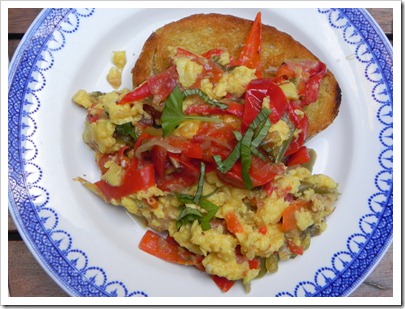
Pipérade and Eggs in Agde

The traditional way to make pipérade and eggs is to heat the pipérade, stir beaten eggs into the mixture, and cook until the eggs are scrambled. Inevitably and invariably the egs curdle, but no one (at least no one Basque) seems to mind. If you’d like uncurdled eggs, warm 2 cups of pipérade in a saucepan. Meanwhile beat 6 eggs with a little salt and pepper in a bowl. Heat 2 tablespoons of butter in a large, non-stick pan over a medium heat, and when the bubbles subside, pour in the eggs, Cook the eggs, stirring, until they form soft curds. Spoon the pipérade into four shallow soup plates and, with the back of a spoon, make a little well in the centre of each. Fill each well with some scrambled eggs. Drizzle the eggs and pipérade sparingly with olive oil, dust with minced basil or coriander, if you’d like, and serve immediately, with slices of warm toasted country bread rubbed with garlic and moistened with oil.

Sunday, 7 November 2010

Feeling Souper

DSCN3155

So I’ve had flu. That’s boring.

Being sick is like staying in a hotel, a really bad hotel where the room is airless, the bed contrives to be both too hot and too cold, the sheets are abominably scratchy despite what the lying bastard label might say about thread count. And nothing on the room service menu tempts, not even the gin and that never happens.

The thing about staying in hotels, even the very, very good ones, is that after about three days I miss cooking. I miss sniffing melons, squeezing avocados, chopping herbs, sautéing onions, simmering stock. Wandering around markets becomes almost unbearable - all that lovely produce and not a pot to put it in.

So on about Day Five of channelling of a consumptive Brontë on the sofa, I just couldn’t stand it. I needed to wash vegetables, fry stuff, stir things, season to taste. This soupy recipe sounded about right. Really very easy. Cook for two hours. Sprinkle with fried onions. Except my kofteh collapsed. You don’t brown them, just roll and poach in the soup. Perhaps I didn’t get the texture of the minced mixture fine enough, but they ended up like lamby crumbs surrounded by creamy, tomatoey, rice. Not so bad. In fact, pretty good for a sick girl.

Eat on a tray in front of an old movie, preferably Mildred Pierce. Blanket and gently snoring dog optional but beneficial. Repeat as necessary.

Kofteh Sholleh
Soft rice meat dumplings

This recipe is from Margaret Shaida’s superlative The Legendary Cuisine of Persia and it was given to her by Mrs Pouran Ataie from Azarbaijan. In her recipe, Mrs Shaida uses 6 fresh tomatoes, peeled and chopped, but I hate peeling tomatoes at the best of times and I didn’t have any and I’m sick so I used a tin of chopped tomatoes. They’re Italian. And good. She also uses 30g dried oregano. I had one whole pot. That’s 5g. I can’t really imagine what adding another five pots would have tasted like and I admit I’m still a bit tastebud-challenged, so I stuck with my paltry, westernised, wimpy sick girl 5g and it tasted great.

Serves six to eight

300g short grain pudding rice
3 medium onions, halved and thinly sliced
2 tbsps groundnut or sunflower oil
2 litres chicken stock
1x400g chopped tomatoes, or 6 tomatoes, peeled and diced
3 tbsps tomato purée
5g dried oregano, or 30g if you’re being authentic
1 tsp paprika or ½ tsp red chilli powder
500g lean lamb or veal, minced
Salt and freshly ground black pepper

Garnish:
1 tbsp groundnut or sunflower oil
1 medium onion, halved and thinly sliced
Finely chopped parsley

Soak the rice in cold water for a few minutes.

Warm the oil over a medium-low heat, add the onions and a pinch of salt and sauté, stirring from time to time, until soft and beginning to turn golden, about 15 minutes. Drain the rice and stir in with the onions. Add enough water to cover, raise the temperature and boil gently, covered, until the water has been absorbed, about 20 minutes. Remove about 3tbsps of rice and set aside.

Add the stock to the rice along with the tomatoes, tomato purée, half the oregano and paprika, salt and pepper. Cover and simmer gently.

Chop the meat together with the reserved rice, remaining oregano and paprika, salt and pepper. Using wet hands, mould into about 10 evenly-sized meatballs. Carefully lower them into the slowly simmering soup. Cook very gently, partially covered, for two hours, stirring occasionally, especially during the last half hour when the dumplings and rice can stick to the bottom if you’re not careful (and even if you are).

While the soup’s cooking, prepare the onions. Warm the oil in a frying pan over a medium-high heat and sauté the onions until crisp and deep golden brown. Drain on kitchen paper while you finish the soup.

Serve the meat dumplings in warmed bowls with the soup ladled over the top and garnished with the parsley and the onions.

Monday, 21 June 2010

French fries

All present and correct

Well the sun came out and, in the fickle way of holiday makers everywhere, I’m grateful for the house’s fortress-like basalt walls which keep the rooms shady and cool. Even on the brightest days, inside you need to turn on a light to read.

June is one of the happiest and most delicious of months in Adge. The market is full of peas and peaches, melons, tomatoes and cherries, everything du region. At one of my favourite stalls, a young man was selling courgette flowers. I bought all he had, about twenty or so, and from another stall enough soft goat’s cheese to stuff them.

Stuffed courgette flowers

Golden and ready to eat

Forgive me, TS Eliot, for saying that I measure out my life in measuring spoons. Quarter of a teaspoon, half a teaspoon, a teaspoon; half a tablespoon, a tablespoon. When I’m developing recipes, accuracy is everything. Measure and measure again. So when I’m on holiday, one of the purest of pleasures for me is to scatter, toss, fling ingredients around with a recklessness that would get me fired in my real life. Here, it just gets me fired up. So you need to forgive me, too, for having no proper measurements in this recipe. But hey, you’re a clever sort, you can figure it out.

Courgette flowers
Soft goat’s cheese
A cup of plain flour
Sparkling mineral water, chilled
Salt
An ice cube
Sunflower or groundnut oil for frying

Carefully peel back the petals of the courgette flowers and remove the stamens. Take a bit of soft goat’s cheese (I was going to say about a teaspoonful, but we’re doing this freestyle, no measuring aren’t we?) and tuck it inside each flower, twisting the petals to close around the cheese.

Stuff carefully

Pour about 10cm of oil into a heavy-bottomed, deep pan. It shouldn’t come more than a third of the way up the sides. Heat up the oil until it measures 180˚C on a thermometer, or, as we’re on holiday, a cube of bread turns golden in just less than a minute.

While it’s heating up, make the batter. In a bowl, mix the flour with a good pinch of salt and enough mineral water to give it the consistency of double cream. I like to throw in an ice cube too, to ensure it’s extra cold. When the fat is hot enough, dip the flowers by their stems into the batter and then carefully drop them into the oil. Don’t crowd the pan – in mine, I can cook about four at a time – and cook until golden, about 3-4 minutes. Scoop the cooked flowers out of the oil with tongs or a spider and leave to drain on kitchen paper while you cook the rest. Serve immediately, sprinkled with a little salt.

Tuesday, 13 April 2010

Up and down the Kingsland Road

Gravadlax

Sometimes, I imagine a shuttle running between Lady de B's house and mine rather like the underground trains that once carried four million letters a day between Paddington and Whitechapel. Our zippy little shuttle wouldn’t transport the Royal Mail. It would carry such precious cargo as extra chairs, baskets, platters, ice cream makers, jelly bags, jam pans, barbecues, tablecloths, ice buckets, stick blenders, mandolins, baking sheets and roasting tins. A truly moveable feast - or the furnishings for one - running the mile or so between my house and hers. It’s not unheard of for me to admire a plate in her house and for her to say, ‘Well, you should like it, it’s yours’.

We cook together so often, plan parties together, eat at one another’s tables with such regularity, that I can find the cling film or cinnamon or colander in her kitchen as easily as I can in my own. I know where the hot spots are in her oven. (Well, at least I did. She’s just got a swanky new Lacanche, and though we’ve been formally introduced, we’re yet to get to know one another intimately over roasted meats, slow-cooked stews, bubbling gratins and biscuits.)

Vanessa and I share recipes obsessively, whether it’s excitably garbled descriptions of dishes we’ve eaten on holidays or in restaurants, inspirations ripped from magazines, or pristine, bookmarked perfection in the pages of the latest cook books.

When Vanessa said she was making gravadlax for Easter lunch, I’d quite forgotten that I’d lent her Falling Cloudberries: a world of family recipes, one of my favourite books because it is filled not just with lovely recipes, but family, history and stories. In her introduction, Tessa Kiros writes ‘These are the recipes I grew up with: the recipes that have woven their way through the neighbourhoods of my mind, past indifference and into love’

Falling Cloudberries Falling Cloudberries

Tessa's mother Tessa Kiros’s mother and a Finnish birch tree.

Born in London to a Greek Cypriot father and a Finnish mother, Kiros’s childhood in Africa was followed by stints cooking all over the world before settling in Tuscany with her Italian husband. It’s hardly surprising her cooking is as diverse as it is delicious. There’s skordalia and semifreddo, couscous and ceviche, tom ka gai and crème brûlée, and in the middle of all that, her mother’s recipe for gravadlax, the happiest of beginnings for our happy Easter feast.

Gravadlax with dill cucumbers

Gravadlax with dill cucumbers

Vanessa bought the salmon from Steve Hatt, fourth-generation fish monger and the north London fisheratti’s piscine purveyor of choice. He advises that for gravadlax, a larger, more mature salmon that had had a chance to build up some fat responds best to the salt and sugar cure. Get the best your pocket can stand, but after that it’s all very easy.

Salmon ready to be sliced

Serves about 20.

300g (10 ½ oz) caster (superfine) sugar
200g (7oz) coarse salt
150g (5oz) dill, chopped
2 whole fillets of salmon, skin left on, but cleaned and small bones removed

For the dill cucumbers:
1 cucumber
1 tbsp chopped dill
100ml (3 ½ fl oz) white wine vinegar
2 heaped tbsps caster (superfine) sugar
1 tsp salt

To serve:
Chopped dill
Finnish mustard (See below)

To make the gravadlax, combine the sugar, salt, dill and a few good grindings of black pepper in a bowl. Put a large piece of foil on your work surface. Onto this put about a third of the salt and sugar mixture. Put one of the fillets, skin side down, on top of the mix then top this with another third of the mixture. Top with the other salmon fillet, skin side up, and cover with the remaining mixture. Pat down so it is all covered nicely and wrap the foil around it to seal the salmon. Keep it in a container in the fridge (Vanessa used a fish kettle, perfect) for four days, turning it over every day. If you don’t have a container large enough, sit it on a tray or large dish to catch nay juices that may drip.

To make the dill cucumbers, cut the cucumber into very thin slices, slightly on the diagonal if you like, so that they are extra long and look good. Put them in a bowl where they will fit compactly in a few layers, sprinkling the dill between the layers. Combine the vinegar, sugar, salt and 2tbsps of water, stirring to dissolve the sugar and salt. Pour this over the cucumber and cover it. Keep in the fridge for at least a few hours before serving. Transfer to a jar and cover with its liquid and it will keep for up to a week.

To serve the gravadlax, remove the foil and scrape off as much of the sugar and salt mixture as possible. Slice the salmon very thinly, horizontally, and scatter with more fresh dill. Serve with the dill cucumbers and Finnish mustard.

Finnish mustard

This keeps really well, sealed in a jar, in the fridge for a few weeks. Its fiery fabulousness will perk up a plate of cold meats, sausages or, yes, cured fish no end.

Makes about 300ml/10 fl oz

45g (1/3 cup) hot English mustard powder
115g (1/2 cup) caster (superfine) sugar
1 tsp salt
250ml (1 cup) single (pouring) cream
1 tbsp olive oil
2 tbsp apple cider (or other, white) vinegar
Juice of half a lemon

Mix the mustard powder, sugar and salt together in a bowl, squashing out the lumps with a wooden spoon. Put in a small saucepan over a low heat with cream, oil, vinegar and lemon juice and bring to the boil, stirring constantly. Cook for 7-8 minutes, stirring often, then remove from the heat when it darkens and thickens. Stir now and then while it cools and then pour into glass jars, seal and refrigerate.

Saturday, 23 January 2010

Stay at home soup

Ready to eat...

I wanted to make soup to go with my khacahpuri so, casting my Georgian bread in the role of posh grilled cheese sandwich, what else could I choose but tomato soup?

In the middle of winter, fat, juicy tomatoes just begging to slip from their skins and transform themselves into soup are as elusive as the all-over tan. Buying these poor, flavourless January specimens is about as tempting (and likely) as getting my legs waxed. So I rely on tinned tomatoes to give me my lycopene fix. All the better because they, and the rest of the ingredients in this soup, are always to be found in my cupboards so I don’t even have to venture out into the dreich afternoon. More fireside time, always a plus.

At this time of year, I seldom team tomatoes with their constant summertime companion, basil. I want the earthy, warming flavours of cumin and paprika, a bit of heat to warm me from the inside out. This combination will keep me going until trotting along to the shops, market basket tucked into the crook of my arm, is a pleasure not a chore and the tomatoes on offer are more fragrant than the packaging that contains them.

Tomato and red lentil soup

Tomato and red lentil soup

1tbsp unsalted butter
1 tbsp olive oil
1 onion, finely diced
2 cloves of garlic, minced
1 tsp ground cumin
½ tsp sweet paprika
1 ½ tbsp concentrated tomato puree
1x400g tin of chopped tomatoes
Pinch of sugar
600ml chicken or vegetable stock
140g red lentils
Salt and freshly ground black pepper
Yoghurt and dill or coriander to serve

Serves four.

Warm the butter and oil in a heavy-bottomed saucepan over a medium-low heat; add the onions and a pinch of salt and sauté, stirring from time to time, until soft and translucent, about 15 minutes. Add the garlic , cumin, paprika and tomato puree and stir for a couple of minutes. Tip the tomatoes, sugar and stock into the pan and simmer for 10 minutes, then pour in the lentils, season and simmer for 25 minutes, partially covered. Adjust the seasoning and puree until smooth in a food processor or with a stick blender.

Adding the lentils

Blending

Return the soup to the pan, cleaned if you’re feeling very virtuous, add more stock or water if it seems a little thick, and warm through. Ladle into warmed bowls, dot a little yoghurt over the top and sprinkle on your herbs. I was swept away on a cloud of Russian nostalgia so I used dill, but coriander would be equally good.

Sunday, 30 August 2009

Postcards from the edge: Part I

Lamb meatballs with minted yoghurt

If you are one of the rather lovely and incredibly discerning people who have followed my blog from the beginning, you may remember back in April when Lady de B and I took on the terrifying (did I say terrifying, obviously I meant exciting) task of catering for our friend Paula’s wedding . Well, the happy day has almost dawned. It’s next Saturday.

The last few weeks have been a blur of bunting and ribbon, table linen and vintage plates, cocktail try outs and canapé platters. And now the cooking is starting in earnest. This week, I’m going to be typing and prepping at breakneck speed, to share with you some of the dishes we’re hoping will launch Paula and Jack deliciously into married life.

If you are the praying sort, I’d be very grateful if you could throw up a few good wishes for a couple of more hours in a day and sunshine on September 5…

Lamb meatballs with minted yoghurt

Dipped

I first made these tasty meatballs for my best friend Victoria’s thirtieth birthday and I’ve made them a million times since. They’re simple and delicious, full of the Middle Eastern flavours I love. I found them in the October 1995 issue of Gourmet and I’ve tinkered with them just a little bit. In the original, they’re rolled in black and white sesame seeds which makes for gorgeous presentation, but one of Paula’s guests is allergic to sesame so I’ve left them out. In the past, in a hurry, I’ve simply mixed the sesame seeds in with the meat rather than rolling them and they were great, too. So sesame, sans sesame, I hope you’ll get rolling and try these out yourself.

Makes about 50.

The Ingredients

1 tbsp olive oil
1 large onion, finely minced
2 garlic cloves, minced
1kg minced lamb
1 tbsp dried mint
1 tsp salt
½ tsp allspice
A good pinch of cinnamon
2 cups of breadcrumbs, about 140g
2 eggs, lightly beaten
4 tbsps currants
Freshly ground black pepper

For the yoghurt dip:
About 300ml whole milk Greek yoghurt
A good handful of fresh mint
A generous pinch or two of salt

Warm the olive oil in a small frying pan over a low heat and fry the onions, with a good pinch of salt, until very soft and slightly golden, about 15 minutes. Add the garlic and fry for a couple more minutes.

Transfer to a large bowl and cool slightly before mixing in the mint, salt, allspice and cinnamon – it’ll smell heavenly at this point. Add the lamb, breadcrumbs, currants and eggs and combine gently but thoroughly. It’s best to do this with your hands as you’re less likely to over-mix. Overmixing makes the meatballs a bit heavy, which is not what you want at all. At this point, break off a small piece of the mixture and fry it in a little oil until golden and cooked through. Taste for seasoning and add more salt and some black pepper if necessary.

Mixing Mixing…

Testing Testing…

Rolling Rolling

Ready Ready.

Take tablespoons of the mixture and roll them gently into balls. You can do this up to a day ahead, cover and chill them in the fridge, or you freeze them at this point as I’m doing.

You need to get the yoghurt dip going a few hours before you want to serve the meatballs. Line a sieve with muslin or kitchen paper and set it over a bowl. Tip the yoghurt into the lined sieve and let it drip, drip, drip away in the fridge for at least four hours or overnight. Just before serving, discard the liquid in the bowl and stir the mint and salt into the creamy yoghurt.

Preheat the oven to 220C/450F/Gas mark 8. Place the meatballs on a baking tray and bake for 8-10 minutes (15 minutes from frozen), rattling the tin half way through, until lightly browned and just cooked through. Serve warm with the yoghurt dipping sauce.

Monday, 6 July 2009

It takes a village …

Patriot jellies
Our friend Stuart could be the sweetest person I know. He has a supernatural ability to divine whether an occasion merits a cup of tea or a stiff gin, he remembers birthdays, charms small children, sends puppies and kittens into paroxysms of joy just by his gentle presence. He’s also gloriously handsome, a quality he wears as carelessly as an old overcoat. Stuart’s always taking care of everyone else so we couldn’t let his 30th birthday pass by without, for once, taking care of him, fêting his fortuitous presence in our lives in a fittingly exuberant manner.
Lady de B and I decided a few weeks ago that we would host a party for him in her garden. He’s Australian, so we thought a posh surf and turf barbecue would be appropriate, a late lunch starting at three o’clock. Simple.
Lady de B and I spent days connected by the umbilical cord of telephone, email and Blackberry discussing the merits of raspberries over passion fruit, marinades or rubs, platters or bowls. We knew we couldn’t do it alone, so we called in the troops. Helder and Steve wired the garden for lights and sound; Kim sent over a restaurant’s worth of white china; Séan got up at 5am to collect flowers and fruit from New Covent Garden market; James spent Saturday morning blowing up inflatable kangaroos and hanging them from the trees along with enough flags and bunting to do an ocean liner proud; Paul ran around town collecting loaves, meringues and prawns; Sarah graciously served up lychee martinis and elastoplasts into the early hours; Alex and the beautiful seňoritas washed a mountain of dishes. We ate and drank and danced until three in the morning.
P1160281Sunny startTime to stop taking pictures!
And then, on Sunday, we did it all again. Ten of us assembled to tidy up and rehash the scandals of the night before. It was a beautiful day so we laid the table in the garden and served up a banquet of leftovers and gossip. By seven o’clock, as we sipped reviving glasses of Sauternes and spooned soft Valençay cheese onto slices of walnut bread, I think we all felt very lucky indeed, blessed in the friendships that have steered us through heartbreak and triumph to find us all together, sitting in the dappled sunshine on a Sunday afternoon in July.
Feet up the next day…All relaxed

Stuart’s birthday menu
Stuart’s birthday spread ~
Bellinis and Kir Royale
Champagne
~
Muhamarra ~
Muhamarra
Bagna Cauda
Radishes with butter & sea salt
Marinated olives
Roasted Chickpeas
~Rib of beef with mustard & horseradish crust ~
Rib of beef with mustard & horseradish crust
Roasted Carliston chillies
Hard core prawns
Director & Lincolnshire sausages
~
Sweet potato gratin
Roasted aubergine & tahini salad
Roasted beetroot & feta salad
Mange tout, green bean, hazelnut & orange salad
Minted new potatoes
Green salad
~
Pavlova with summer fruits
Patriot jellies
Chocolate dipped strawberries
Lychee martinis
~
Colston Bassett Stilton
Parmesan
English & Irish goat cheeses
Homemade de Beauvoir pear chutney
Figs and sultana grapes
Saturday’s pavlova becomes Sunday’s Eton Mess, eaten from one big plate in the middle of the table, with ten spoons.
Eton messEton Mess going.......gone

Monday, 13 April 2009

Happy, happy Easter

Every Good Friday, our friend Richard throws my favourite party of the year: The Easter Jamboree. He and Emma started this tradition a dozen or so years ago for the waifs and strays left in London for the holiday and it has grown so much that up to 50 of us now stay in the city to join the festivities each spring. We take over a first-floor terrace restaurant in Covent Garden for rosé and steak frites, gossip and occasional scandal. What starts as lunch usually ends up in a bar somewhere. This year, 1am found us in Richard’s flat with Séan teaching our Spanish friend Alex to do the Eightsome Reel while I raided the fridge to rustle up spring onion and salmon frittata for the dozen or so merry survivors.

After such a great party, a post mortem is essential. We usually have a lunch here on Easter Sunday where newspapers are read, champagne is drunk and the various levels of wickedness displayed on Friday are dissected in near-forensic detail. Who fell of a chair? Who ran off with that cute waiter? Did anyone break a glass, a limb, a heart?

I spent Saturday in the gently soothing activity of preparing the feast for the following day - hummus and lebneh balls dipped in smoked paprika and toasted sesame seeds, platters of salami, and my first-ever dolma. I spent a happy few hours soaking and filling vine leaves. Sometimes the world - or at least the television schedulers - are kind, so I sat at my kitchen counter and rolled my vine leaves while watching My Big Fat Greek Wedding. As they simmered on the stove, they filled the house with their reviving and comforting lemony, spicy aroma.


After our Mediterranean canapés, we reverted to trad English for our main course: the tenderest Poll Dorset Spring Lamb from the Thoroughly Wild Meat Company which I seasoned and rubbed with butter and then simply roasted on a bed of rosemary, chopped onion and wet garlic, along with roasted asparagus from the Wye Valley and sweet, boiled Jersey Royals. For pudding, we devoured a strawberry and chocolate roulade and the heavenly Lemon Meringue Bombe from the Unconfidential Cook’s blog.


As we kissed the last of our 15 friends goodbye at 11pm, I was delighted that they’d come, thrilled they’d enjoyed themselves, but secretly excited that they’d left us with just enough lamb to fill a couple of pitas with the last scraps and some scrambled eggs and chopped mint for supper today.


Dolma In the 11 years I’ve lived in this part of London, I must have eaten enough stuffed vine leaves to stretch all the way along Green Lanes and back, from the Turkish part where they’re called dolma to the Greek end where they’re known as dolmades. But I’ve never made them. Seeing a vine press in the Turkish Food Centre pushed me over the edge from consumer to creator.

A 750g package of pickled vine leaves, soaked in warm water for 10 minutes then drained, stalks cut off

125ml olive oil
2-3 onions, finely diced
50g pine nuts
250g short-grain rice
50g currants
1tbsp dried mint
1 tsp allspice
½ tsp ground cinnamon
1 ½ tbsps lemon salt *
250ml chicken stock
1 tomato, grated
A good-sized bunch of parsley, stalks removed then finely chopped
2tbsps finely chopped, fresh dill
1 small lemon, sliced
Freshly ground black pepper

*You can find tangalicious lemon salt in Mediterranean supermarkets. If you can’t get hold of any, use a teaspoon or so of ordinary salt and the juice of half a lemon.

Warm half of the olive oil in a large frying pan over a medium-low heat and sauté the onions until soft and translucent, about 15 minutes. Add the pine nuts and fry until they begin to turn golden. Add the rice and fry, stirring, for about 5 minutes until the rice is well coated in the oil. Add the currants, spices, dried mint and lemon salt, stir and pour in half of the chicken stock and simmer gently until most of the liquid is absorbed. Add the rest of the stock and simmer again, stirring quite frequently, until it is absorbed. Remove from the heat and add the grated tomato, fresh herbs and a good few grinds of black pepper. Cool.

Line a large, heavy casserole with a good layer of vine leaves (check through the ones you’ve soaked. They’ll inevitably be a few that are too small or torn – use those.) and a couple of slices of lemon.


Now, let the rolling extravaganza begin. Place a leaf in front of you, vein side up and the broadest part of the leaf facing you. Put a spoonful of the mixture about 1cm up from the base of the leaf. Fold over once, then fold in the sides and roll. I was daunted by warnings of not overfilling the leaves in case they split while cooking, so mine were a little thin. A think a good, rounded tablespoon of filling would be perfect. Line the base of the casserole with a layer of stuffed vine leaves, packing them in quite tightly. Place a couple of slices of lemon on top and make your next layer. Keep rolling and layering until you’ve used up all of your leaves and rice mixture. Pour over the rest of the olive oil and about 300ml of boiling water. Put a vine leaf press or a plate on top of your dolma to stop them bobbing around in the liquid and simmer very gently, covered, for about 35-45 minutes until almost all of the liquid has been absorbed. Serve warm or at room temperature.
Related Posts Plugin for WordPress, Blogger...