
In 1990 and 1991 I lived in Moscow, on the seventh floor of a concrete block in Oktyabrskaya Ploshchad. Had our apartment been on the right side of the building, we would have looked out on a towering bronze statue of Lenin, his coat flapping in the wind as he gazed sternly towards Gorky Park. As it was, we looked out onto a car park full of faded, boxy Ladas and shiny, boxy Volvos. At night, rats performed their own ravenous ballet in the open rubbish bins.
We had a full-time maid, Katya, and a driver, Uri. This sounds grand but in those days it was mandatory for foreigners. It was how, during the last, brittle glimmers of the communist super power, the authorities kept track of what we were doing, who we were seeing.
Each morning, I asked Katya ‘How’s the weather?’. In winter, she had a special glint in her eye. ‘Oh, minus 25°C,’ or, even better, “Minus 30°C!” “That’s very cold,” I’d say, taking a quick, comforting slug of steaming coffee. “Oh, it’s not so bad. It’s just the way I like it!” she’d say, unpeeling coat, hat, scarf and gloves from her short, round body and changing her thick boots for dainty patent leather shoes. No wonder Napoleon and Hitler didn’t stand a chance against these people.
Our flat had a sitting room, two small bedrooms a kitchen and a bathroom. I could, with a little stretching, have dusted the whole place from the hallway. Not much for Katya to do. I was 24 years old, excited, a bit scared. I’d had a few Russian lessons from a long-lashed, razor-cheeked Serb called Zoran in a bedsit in Earl’s Court. I’d just about mastered the Cyrillic alphabet and learned how to say zdrah-stvooy-tee. I remember thinking that it was hardly surprising a nation with such a long word for ‘hello’ had a reputation for being unfriendly.
So Katya became my Russian teacher. We drank tea and talked. Sometimes we went out and talked. Sometimes we bought ice cream, even in winter, or hot beef pastries from vendors outside the Oktyabrskaya metro station. She taught me how to use the underground and take a tram, how to pay in shops. (See something in a cabinet and ask to look at it, ask the sales person for a ticket, queue up at another counter to pay for it, go back to the first counter with your receipt and collect your purchase, which would then be carefully wrapped in brown paper. You better not be in a hurry.) And, most importantly, she took me to the markets.
I loved the huge Centralny Rynok, the Central Market, the best. In the main hall, there were flower stalls selling chrysanthemums with creamy, billowy heads the size of turnips and carnations dyed lurid shades of electric blue, stalls heaped with walnuts and raisins, strings of dried mushrooms, barrels full of pickled cabbages and cucumbers, boxes of perky lettuce, crates of potatoes and carrots, bunches of dill, coriander and parsley as big as a Cossack’s fist, little bundles of thyme and bay, baskets of lemons and oranges. Citrus fruits were brought up from the southern republics in suitcases by gold-toothed sellers who took advantage of air fares fixed by the state years ago, so selling a few lemons was enough to pay for their 2000 mile round trip between Tblisi and Moscow.
Behind the main hall, there were two long, low buildings. The one on the left sold meat, everything from rows of waxy piglets to legs of lamb, ribs of beef and enormous slabs of pork. In the white-tiled building on the right, stout women with white overalls buttoned tightly over their woollen coats sold milk, yoghurt, cream and cheese in old jam jars and brown paper bags filled with eggs.
In London, I’d bought fruit and veg from the cheerful blokes on Berwick Street Market, tiny, beautiful single-girl lamb cutlets from the butcher on Brewer Street, sardines from the fishmonger on Endell Street, garlicky slices of salami from I Camisa on Old Compton Street. When I left work late, or towards the end of the month when funds were running low, I’d pick up things for dinner at Sainsbury’s on the Finchley Road. Neat. Clean. In Moscow, I was thrown into a world of grubby vegetables and strange cuts of meat sold by men in dirty aprons. Katya taught me to hunt down the finest produce, negotiate the best prices. I enjoyed, for the first time in my life, a sense of the seasons passing. After a long winter and chilly spring, the first strawberries, tomatoes and French beans were more tempting than gold.
In a city where pensioners lived on 90 roubles a month, less than I’d pay for a leg of lamb, I learned not to waste a scrap. In my kitchen on the seventh floor, I cooked simply and entertained a lot. There were few restaurants, so we often ate in each other’s homes. I’d packed Mediterranean Food by Elizabeth David, I think because I imagined reading her sensual prose would see me through a bleak Russian winter. But I cooked from it, working my way through its pages, tumbling my Russian vegetables in her French dressing, turning fat little mushrooms into her champignons a la provençale and transforming those Georgian citrus into crème a l’orange. Julia Child said, ‘You learn to cook so that you don't have to be a slave to recipes. You get what's in season and you know what to do with it.’ Well, in those dark winter months, I had time, great ingredients, a warm kitchen, an eager audience and, most importantly, Mrs David at my side, teaching me from her recipes how to cook without recipes.
So there you have it. How I really learned to cook. From Russia, with love. And a licked spoon.
Khachapuri
 The khachapuri is on a board I bought in Moscow and have used almost every day since.
Borsch is all well and good, but when I lived in Moscow the foods I enjoyed most were the ones I enjoyed in its handful of Georgian restaurants. Shashlyk, or shish kebab, chicken in walnut sauce, raisiny plov, or pilaf, marinated aubergines…in fact, they were a lot like the dishes I eat now, in Stoke Newington’s many Turkish cafes. The one thing I loved then and crave now is khachapuri, thin breads filled with salty cheese, eaten quickly while they were still hot from the oven. I was thrilled to find a recipe for them in Jill Norman’s delightful Winter Food: Seasonal Recipes for the Colder Months. Jill Norman, Elizabeth David’s editor and literary executor, is an elegant, masterful writer in her own right. If you want to silence that screaming internal yearning for spring, buy this book.
Serves 8
3 eggs
175ml yoghurt
200g plain white flour, plus extra for dusting
½ tsp salt
½ tsp bicarbonate of soda
50g cold butter, cut up into pieces, plus extra for greasing
450g cheese, a mixture of feta or havarti and crumbly white cheese such as Wensleydale or white Cheshire or Lancashire work well
 Getting it all together.
 Mixture of feta and Wensleydale.
 Mixing the flour in with the yoghurt and eggs.
 Shaping the dough.
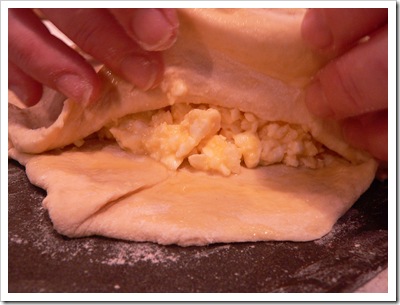 Forming the khachapuri.
Preheat the oven to 180C/350F/gas mark 4. Beat 1 egg in a large bowl and stir in the yoghurt. Mix together the flour, salt and bicarbonate of soda in another bowl and rub in the butter until the mixture resembles fine breadcrumbs. Add the flour mixture to the yoghurt and stir to form a dough. Add a little more flour if it is too soft. Knead into a smooth, elastic dough and leave to rest while you prepare the cheese.
Grate or crumble the cheeses coarsely. Beat the second egg and stir it into the cheeses. Set aside. In Jill Norman’s recipe, she divides the dough into eight pieces, rolls each one on a floured board to a circle of about 12-14cm diameter and puts one eighth of the cheese mixture in the centre. Then she gathers up the sides to meet in the centre and either crimps the edges together to enclose the cheese completely, or leaves them slightly open. I decided to make one large round, so I divided the dough in two, rolled out the bottom into a circle, spread the cheese out on top, brushed the edges with egg and placed the second layer on top, crimping the edges firmly. Put the bread/s onto a large, greased baking sheet. Brush with the third beaten egg and bake for 25-30 minutes until browned. The bread is best served hot or warm. Serve it as a satisfying first course or with a salad as a light meal. I served mine with tomato and lentil soup – I’ll post the recipe next week.


